

Table of Contents
- What You'll Need to Inspect Pearl Nacre Quality
- Visual Cues: How to Check Pearl Nacre Quality by Eye
- Pearl Nacre Thickness Standards Explained
- Hands-On Tests for Measuring Nacre Thickness
- Signs of Low Quality Pearls to Watch For
- How to Care for Natural Pearls So Nacre Lasts
- Frequently Asked Questions
Last Updated: September 20, 2026
What You'll Need to Inspect Pearl Nacre Quality
You don't need a lab to judge a pearl. You need good light, a clean cloth, and a few minutes of patience. This guide from Glamorous by Katre walks you through how to check pearl nacre quality before you buy, so a dull strand never catches you off guard again.
Pearl nacre is the iridescent coating a mollusk layers around a nucleus to form the pearl. Its thickness decides how the pearl looks today and how long it keeps looking that way.
Gather these basics first:
- A soft, lint-free cloth
- A bright, indirect light source, like a window
- A magnifying loupe, if you have one
- A small scale for weighing pearls, optional
Natural pearls and freshwater pearls deserve the same close look. A common mistake is judging by price alone. A higher price does not always mean thicker nacre.
Visual Cues: How to Check Pearl Nacre Quality by Eye
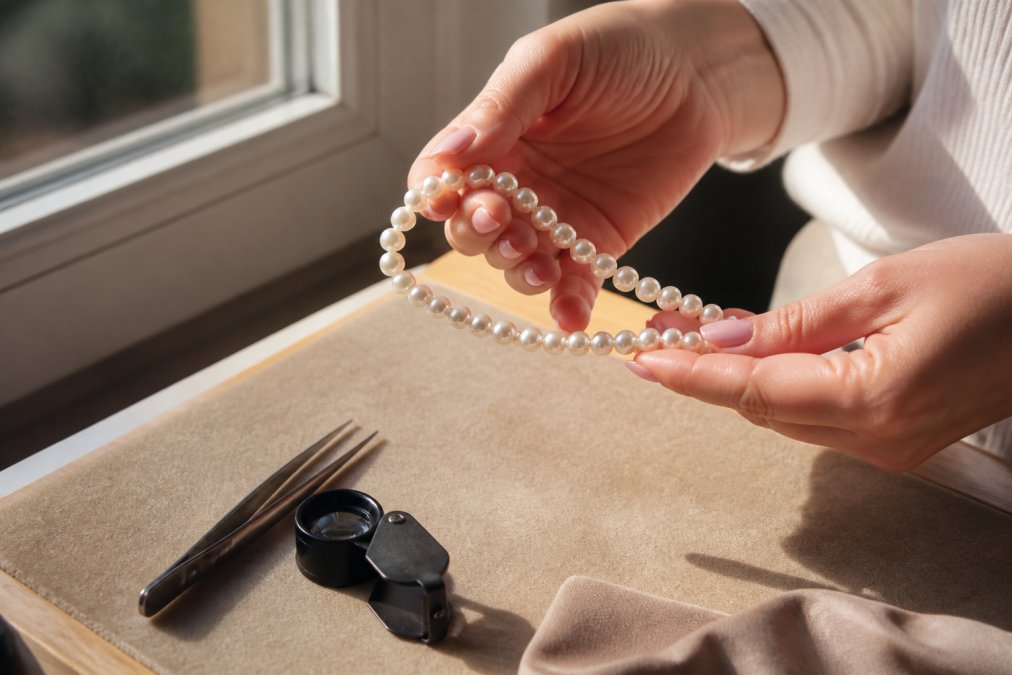
Start with your eyes. Most quality clues show up in the first thirty seconds of holding a pearl to good light. Learning to check pearl nacre quality visually saves you from relying on a seller's word.
Reading Luster and Overtone
Luster is the sharpness of the light reflecting off the surface. A pearl with thick nacre reflects light like a mirror, and you can almost see your own face in it.
Overtone is the subtle color that sits on top of the pearl's base shade. Pink, green, and silver overtones are common. A pearl with rich, deep luster and a clear overtone usually has healthy nacre beneath.
Flat, chalky reflections point the other way. If the surface looks like dull plastic, the nacre is thin or the pearl has dried out.
Spotting the Nucleus Through Thin Nacre
Hold the pearl up to a light. On a thin-nacre pearl, you may see a dark shadow or a faint outline of the bead inside. That bead is the nucleus the mollusk coated.
A sharp, visible nucleus edge is a warning sign. Thick nacre hides the core almost completely. If you can trace the round bead through the surface, walk away or ask more questions.
Pearl Nacre Thickness Standards Explained
Pearl nacre thickness standards describe how deep the coating should be for a pearl to hold up over time. There is no single legal number in the United States, but the trade has loose expectations.
Here's the practical breakdown:
| Nacre Depth | What It Means | Typical Wear |
|---|---|---|
| Very thin | Nucleus shows through, dull sheen | Chips and peels fast |
| Thin | Faint core visible, soft luster | Wears within a few years |
| Medium | Core hidden, good shine | Holds up with care |
| Thick | Deep mirror luster, no core visible | Lasts for decades |
For saltwater pearls, growers often aim for a coating well over half a millimeter. Freshwater pearls can run thinner and still look lovely. The point is not the exact number. It's whether the nacre hides the core and keeps its shine.
Ask any seller how thick the nacre is. A confident answer is a good sign. A vague one tells you plenty.
Hands-On Tests for Measuring Nacre Thickness
Your fingers and eyes can do more than you'd expect. These simple tests help you check pearl nacre quality without special equipment.
The Light Test and Surface Glide
Hold the pearl against a bright, diffused light. Turn it slowly. Thick nacre glows evenly with a soft inner light and no dark patches.
Next, run the pearl gently across your front teeth or a smooth surface. A well-coated pearl glides with a slightly gritty, matte feel. A slick, glassy slide often means thin nacre or a fake.
When to Ask for a Professional X-Ray
Some sellers offer an X-ray or radiographic image of the pearl. This shows the nucleus and the nacre layer clearly. It's the closest thing to a guarantee.
Ask for one when the price is high or the pearl is a major purchase. If a seller can't provide it, weigh that against the other signs you've seen.
Signs of Low Quality Pearls to Watch For
Certain flaws give thin or poor nacre away fast. Train your eye on these signs of low quality pearls before you commit to a purchase.
Watch for:
- A chalky, flat surface with no depth
- A visible nucleus or dark shadow inside
- Peeling, flaking, or cracked coating
- Uneven color patches across the surface
- A slick, plastic-like feel
- Dull spots that don't change as you turn the pearl
Any one of these is a reason to slow down. Two or more together usually means the nacre is failing.
How to Care for Natural Pearls So Nacre Lasts
Good care keeps nacre thick and bright for years. Nacre is soft compared to metal and stone, so it scratches and dries out easily.
Follow these habits:
- Put pearls on last, after perfume and hairspray
- Wipe them with a soft cloth after each wear
- Store them in a soft pouch, away from other jewelry
- Restring strands every year or two if worn often
- Keep them away from heat, sun, and harsh cleaners
To learn how to care for natural pearls properly, treat them like a delicate fabric, not a rock. A little routine goes a long way.
At Glamorous by Katre, every piece is built around natural pearls and precious metals. When you're ready to add a lasting piece to your collection, our freshwater pearl earrings start at $59 and are made to be worn, not stored away. Consider our Natural Freshwater Pearl Knot Style Stud Earrings for $59.00, crafted with natural freshwater pearls and 18k gold plated sterling silver pins, perfect for everyday elegance. Search for them today.

Frequently Asked Questions
What is considered good nacre thickness for a pearl?
For akoya pearls, good nacre thickness is generally 0.4 millimeters or more. South Sea and Tahitian pearls typically have nacre between 2 and 6 millimeters. Freshwater pearls are almost entirely nacre, often 3 to 5 millimeters thick. Thicker nacre means the pearl will hold its luster longer and resist wear. When shopping, ask the seller for the nacre thickness or look for certification that states it.
How can you tell if a pearl has thin nacre?
Thin nacre shows up as a chalky or dull surface instead of a deep mirror-like glow. Under strong light, you may see the bead nucleus through the nacre, especially near the drill hole. Sharp edges or flat spots on the surface also signal thin nacre, because the coating has worn away. Rub two pearls together gently: thin nacre feels smooth and glassy, while thick nacre has a slight gritty resistance.
Does nacre thickness affect the value of a pearl?
Yes, nacre thickness is one of the strongest drivers of pearl value alongside luster, surface quality, and size. Pearls with thick nacre take longer to form, hold their shine for decades, and resist peeling or cracking. A thick-nacre pearl can command a significantly higher price than a thin-nacre pearl of the same size. When you pay more for a pearl, you are often paying for the years of nacre deposition inside the shell.
How do you care for natural pearls to protect the nacre?
Wipe pearls with a soft damp cloth after each wear to remove oils and perfume. Store them in a soft pouch or lined box away from harder jewelry that can scratch the surface. Put pearls on last when dressing and take them off first at night. Restring pearl strands every one to two years if you wear them often. Avoid ultrasonic cleaners, steam, and household chemicals, which strip the nacre over time.
Thin nacre is the quiet flaw that turns a beautiful pearl dull within a few years. Knowing how to check pearl nacre quality before you buy protects both your money and your joy in wearing it. Glamorous by Katre crafts jewelry with natural pearls, gemstones, and 18k gold plating, designed to last a lifetime. Explore the collection and find a piece that keeps its shine for decades to come.