

Table of Contents
- Why Natural Pearls Need Gentle Care
- What You'll Need to Clean Natural Pearls Safely
- Step-by-Step: How to Clean Natural Pearls Safely
- The Best Cloth for Cleaning Pearls (and What to Avoid)
- Why Do Pearls Turn Yellow? Causes and Fixes
- How to Store Natural Pearls to Prevent Damage
- Restringing and Long-Term Maintenance
- Common Mistakes That Damage Natural Pearls
- Frequently Asked Questions
Last Updated: September 13, 2026
Why Natural Pearls Need Gentle Care
A natural pearl forms when a mollusk coats an irritant with layer upon layer of nacre, the substance that gives pearls their depth and luster. That nacre sits at roughly 2.5 to 3.5 on the Mohs hardness scale, softer than window glass. At Glamorous by Katre, we handle natural pearls daily, and the first thing we tell every customer is simple: the care routine you use for gold and diamonds will destroy a pearl.
Nacre is porous, absorbing whatever touches it, from skin oils to hair spray. Once a harsh chemical works its way in, the damage is permanent, you cannot polish it out the way you would buff a scratch from metal.
That's why learning how to clean natural pearls safely matters more than any other piece in your jewelry box. Below are the supplies, steps, and storage habits that keep nacre luminous for decades.
What You'll Need to Clean Natural Pearls Safely
You need less than you'd expect. Gather these before you start:
- A soft microfiber cloth or lint-free cotton cloth
- A small bowl of lukewarm water
- Mild dish soap, unscented and dye-free
- A second dry, soft cloth for drying
- A soft-bristled makeup brush for intricate settings
Skip anything abrasive. According to guidance from the Gemological Institute of America on pearl care, pearls should never be cleaned with ultrasonic cleaners, steam cleaners, or ammonia-based solutions. Those tools are built for hard stones, and they strip nacre.
Step-by-Step: How to Clean Natural Pearls Safely
The full process takes about ten minutes for a necklace and requires no special equipment. Follow these steps in order, and never rush the drying stage.
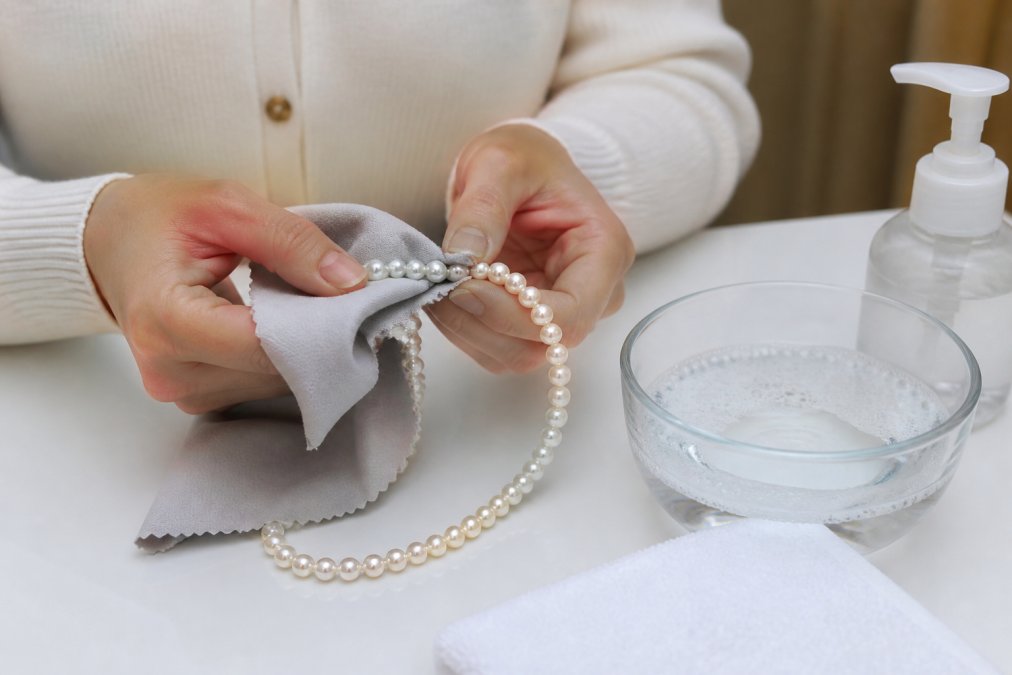
Step 1: Prepare Your Workspace
Lay a soft towel flat on a clean surface so a slipped pearl lands on fabric, not tile or hardwood. Fill a small bowl with lukewarm water and add one drop of mild dish soap. Hot water damages nacre, and cold water doesn't lift oils as well.
Step 2: Wipe Pearls After Each Wear
This is the step most people skip, and it matters most. Before your pearls go back in the box, wipe each one with a soft damp cloth. Skin oils, perspiration, and cosmetics absorb into nacre immediately; a fifteen-second wipe after every wear removes them before they cause dullness. Let the strand air dry completely before storing.
Step 3: Deep Clean with Mild Soap and Water
For a deeper clean, dip your microfiber cloth into the soapy water, wring it until barely damp, and wipe each pearl individually. Use the soft brush around the clasp and intricate settings.
Rinse the cloth in clean lukewarm water, wring it out, and wipe again to remove soap residue. Do not soak the strand, silk thread absorbs water, weakens, and stretches when wet.
Lay the pearls flat on a dry towel and let them air dry completely, away from direct heat or sunlight. Never hang a wet strand, because the weight of the water stretches the thread.
The Best Cloth for Cleaning Pearls (and What to Avoid)
A soft microfiber cloth is the best choice for cleaning pearls because its fibers lift oils without scratching nacre. Lint-free cotton is a fine backup.
Here's the honest comparison:
| Cloth or Tool | Safe for Pearls? | Why |
|---|---|---|
| Microfiber cloth | Yes | Lifts oils, no lint, no abrasion |
| Soft cotton cloth | Yes | Gentle, but can leave fibers |
| Paper towel | No | Wood fibers scratch nacre |
| Ultrasonic cleaner | No | Vibration cracks nacre |
| Steam cleaner | No | Heat damages the surface |
| Abrasive cleaners | No | Strip away layers of nacre |
Microfiber holds onto oils over time, so wash your cloths separately with mild soap and air dry them, or replace them every few months.
Why Do Pearls Turn Yellow? Causes and Fixes
Yellowing is not a surface stain you can wipe away. It is a chemical change inside the nacre itself, and understanding the mechanism is the difference between slowing it down and losing the pearl's luster permanently.
What Is Actually Happening Inside the Nacre
Nacre is built from microscopic plates of aragonite (a form of calcium carbonate) cemented together by conchiolin, a protein. That structure produces the pearl's orient, the deep, layered glow that shifts as you move it, and it is why the pearl is porous: the conchiolin between the aragonite plates absorbs whatever it contacts.
When skin oils, perspiration, and cosmetic residue soak into that protein matrix, they oxidize over months and years. Oxidation darkens the conchiolin, and because it sits between the light-reflecting aragonite plates, the darkening shows through as a warm, yellow-brown cast. The change is gradual, which is why most people do not notice until a strand looks warmer next to a newer one.
The Culprits, Ranked by How Fast They Act
Not every exposure does equal damage. From fastest to slowest:
- Perfume and cologne. Alcohol carries fragrance oils deep into the porous nacre, and it evaporates slowly once inside. This is the single fastest route to yellowing.
- Hair spray and aerosol products. The propellants and resins deposit a tacky film that traps dust and skin oils against the surface.
- Body lotion and sunscreen. Emollients and UV filters are designed to bond to skin, and they bond just as readily to conchiolin.
- Hairspray residue on hands. Touching your hair and then handling a strand transfers product directly.
- Skin oils and perspiration. Slower acting, but constant. This is why the post-wear wipe matters even on days you wore no cosmetics.
The Prevention Routine That Actually Works
The fix is sequencing, not cleaning. Build this order into your getting-ready routine:
- Shower and dry your hair first.
- Apply lotion, sunscreen, and any skincare.
- Apply perfume or cologne, to pulse points, never to the pearls.
- Let everything dry completely. Give it a full five minutes; damp product transfers on contact.
- Put your pearls on last, after your clothing is on and hair products have settled.
- Take your pearls off first when you get home, before you change or remove makeup.
Can Yellowing Be Reversed?
Sometimes, mildly, and only at the surface. A careful wipe with a barely damp cloth after each wear removes fresh residue before it oxidizes, and a jeweler can sometimes lift shallow surface film with a gentle professional cleaning.
But once discoloration penetrates the conchiolin between the aragonite plates, no home method restores the original luster. Abrasive remedies, toothpaste, baking soda, vinegar, do not brighten the pearl; they remove nacre, and the layer beneath is thinner and less lustrous. Maintenance beats correction every time, which is why the prevention sequence above is the only reliable strategy.
How to Store Natural Pearls to Prevent Damage
Storage is where most pearl damage happens quietly. A strand can sit untouched for a year and come out duller than it went in, because the environment, not wear, did the harm. Getting storage right costs nothing and protects everything.
The Three Rules of Physical Storage
- Flat, never hanging. Silk thread stretches under the weight of the pearls, and a strand hung on a hook will develop gaps between pearls within a year or two. Lay it flat in a box or tray.
- Separated, never loose in a drawer. Pearls scratch at roughly 2.5 to 3.5 on the Mohs scale, softer than window glass. A single metal clasp or gemstone sharing the compartment will scuff nacre. Give each strand its own soft pouch or a compartment lined with fabric.
- Breathable, never sealed in plastic. Airtight plastic traps residual moisture against the nacre and, in dry climates, can pull ambient moisture out of the pearl over time. A fabric-lined jewelry box or a soft cloth pouch allows the small amount of air exchange nacre needs.
Humidity and Temperature: The Part Most Guides Skip
Nacre is roughly 2 to 4 percent water by weight, held within the conchiolin, and that water content helps keep the pearl lustrous. Let it dry out and the conchiolin shrinks, the aragonite plates lose alignment, and the orient dulls. Let it get too damp and you invite mold and thread rot.
The practical target most conservators and jewelers work within is 45 to 55 percent relative humidity at a stable room temperature, roughly 65 to 70 degrees Fahrenheit. You do not need a museum-grade case; a fabric-lined jewelry box in a normal, climate-controlled room lands in range in most homes.
What to avoid:
- A dry safe or vault with no humidity control. These can drop below 30 percent relative humidity and slowly desiccate nacre. If you store pearls in a safe, keep them in a fabric pouch inside a sealed container with a humidity buffer, or move them to a climate-controlled drawer.
- A bathroom or above a radiator. Steam, heat, and rapid humidity swings are all hard on nacre and on the silk thread.
- Direct sunlight and display cases near windows. UV exposure fades the luster and can yellow the conchiolin over years.
- An attic, garage, or unheated storage unit. Temperature swings cause the nacre and the thread to expand and contract at different rates, which stresses both.
Long-Term Storage for Heirloom Strands
If a strand is going into storage for months or years rather than being worn, a few extra steps protect it:
- Wipe each pearl with a soft dry cloth before it goes away, so no residue sits on the surface.
- Restring before long-term storage if the thread shows any fraying, since a weak thread may snap the first time the strand is worn again.
- Check on the strand every six months. Open the pouch, let it breathe, and look for dulling, thread discoloration, or gaps between pearls.
- Store the pouch inside a larger box with a small humidity buffer, a silica packet is the wrong tool, since it pulls moisture out; a humidity-control packet designed to hold a target range is the right one.
A strand stored this way can come out of a decade of rest looking the way it went in. A strand stored in a dry safe or a plastic bag will not, no matter how carefully it was cleaned.
Restringing and Long-Term Maintenance
Restringing is the maintenance step almost every care guide ignores, and it's the one that saves necklaces. Silk thread stretches, weakens, and absorbs sweat over years of wear, and a strand that snaps scatters pearls across a room.
Have a strand restrung every one to two years if you wear it regularly, or every three years for occasional wear. If you see fraying near the clasp, gaps between pearls, or uneven hanging, take it in sooner.
For more on how professional jewelers evaluate pearl condition and structure, see the American Gem Society's guide to pearl jewelry care.
Ask your jeweler to knot between each pearl. Knotting keeps pearls from rubbing against each other and prevents total loss if the thread breaks.
Common Mistakes That Damage Natural Pearls
The most damaging mistakes are the ones people make out of good intentions. Here are the ones we see most often.
- Soaking a strand overnight. Water weakens silk thread and can leave residue inside the drill holes.
- Using toothpaste or baking soda. Both are abrasive and scratch nacre permanently.
- Spraying perfume directly on pearls. Alcohol and oils in fragrance penetrate the porous surface and speed yellowing.
- Storing pearls in a plastic bag. Trapped moisture and lack of airflow harm nacre over time.
- Wearing pearls in the pool or shower. Chlorine and hot water both attack the surface.
- Cleaning with an ultrasonic device. Vibration cracks nacre and can shatter a thin pearl outright.
- Skipping the post-wear wipe. This is the single habit that separates pearls that stay lustrous for decades from pearls that dull within a few years.
If you're unsure whether a piece needs professional attention, err on the side of a jeweler's assessment. For a broader reference on handling delicate organic gemstones, the Smithsonian's gem and mineral collection resources offer useful context on how museums preserve fragile organic materials.
Frequently Asked Questions
Can I clean natural pearls with Dawn dish soap?
Mild dish soap can work in a pinch, but it must be free of harsh detergents, fragrances, and moisturizers. Many dish soaps contain ingredients that strip the nacre and leave residue. A better choice is a gentle, fragrance-free soap labeled for delicate items or a drop of mild baby shampoo. Always dilute it in lukewarm water and rinse thoroughly with a damp cloth.
Do real pearls turn yellow over time?
Yes, natural pearls can yellow as they age, especially if they are exposed to oils, perspiration, cosmetics, or stored in humid conditions. The nacre absorbs substances over time, causing dullness and discoloration. Proper cleaning after each wear, storing them in a soft pouch away from heat and moisture, and avoiding contact with perfume and hair spray can slow yellowing. Some yellowing is irreversible, but gentle care preserves luster.
How do you store natural pearls to prevent damage?
Store natural pearls in a soft cloth pouch or a lined jewelry box, separate from harder gemstones and metals that can scratch the nacre. Avoid airtight plastic bags, which trap moisture and can cause yellowing. Keep them away from direct sunlight, heat, and humidity. A silk or velvet pouch works well, and laying them flat prevents the silk thread from stretching.
What household items should never touch natural pearls?
Never use ultrasonic cleaners, steam cleaners, bleach, ammonia, vinegar, baking soda, toothpaste, or abrasive cleaners on natural pearls. These can strip the nacre, cause chemical damage, and leave the surface dull and pitted. Also avoid hair spray, perfume, cosmetics, and lotions, which contain acids and oils that penetrate the porous surface. Always put pearls on last and take them off first to minimize contact with these substances.
Caring for natural pearls comes down to consistency, not effort: a quick wipe after every wear, gentle soap when needed, and flat storage in a soft pouch. At Glamorous by Katre, every piece is built to be worn and enjoyed for a lifetime, not locked away. Our natural pearl collection pairs hand-selected nacre quality with craftsmanship designed for everyday elegance. Browse the collection and find a strand made to last.