

Table of Contents
- Why Handcrafted Natural Pearl Earrings Are Worth the Investment
- Quick Comparison: Handcrafted Pearl Earrings by Style and Price
- How to Identify Natural Pearls Before You Buy
- Natural vs Cultured Pearl Earrings: What's the Real Difference?
- Top Handcrafted Natural Pearl Earrings to Buy in 2026
- Pearl Grading and Size: Choosing the Right Pair for Your Face Shape
- Handcrafted Pearl Jewelry Care Tips for Daily Wear
- Conclusion
- Frequently Asked Questions
Last Updated: September 14, 2026
Why Handcrafted Natural Pearl Earrings Are Worth the Investment
Handcrafted natural pearl earrings are assembled by hand from genuine pearl-bearing mollusks, set in precious or gold-plated metals, and finished by an artisan rather than a production line. This guide from Glamorous by Katre covers what to inspect, what to pay, and which pairs hold up to daily wear.
Handcrafting comes down to control: a maker can reject a dull pearl, match a pair for luster and shape, and seat each stone by hand so the setting grips without crushing the nacre.
Quick Comparison: Handcrafted Pearl Earrings by Style and Price
| Style | Pair | Material | Price | Best For |
|---|---|---|---|---|
| Art Deco geometric | Art Deco Geometric Pearl Earrings | 18k gold plated | $105.00 | Entry point, modern minimalists |
| Art Deco freshwater | Art Deco Freshwater Pearl Earrings | 18k gold plated, sterling pin | $124.00 | Architectural taste |
| Diamond and pearl | Diamond and Freshwater Pearl Earrings | 925 sterling silver | $220.00 | Day-to-evening versatility |
| Baroque drop | Antique White and Pink Baroque Pearl Drop Earrings | 18k gold plated | $220.00 | Statement dressing |
| Butterfly motif | Butterfly Diamond and Freshwater Pearl Earrings | 925 sterling silver | $315.00 | Romantic gifting |
| Knot stud | Natural Freshwater Pearl Knot Style Stud Earrings | 18k gold plated | $380.00 | Office wear, low maintenance |
| Jade baroque | Luxurious White, Pink and Purple Freshwater Pearl Earrings with Green Jade | 18k gold plated, natural jade | $405.00 | Color-led collections |
| Star motif | Diamond Star and Freshwater Pearl Earrings | 925 sterling silver | $410.00 | Vintage-leaning wardrobes |
| Victorian ruby | Elegant Ruby and Diamond Freshwater Pearl Earrings | 925 sterling silver, zircon | $1,420.00 | Heirloom-level occasions |
Every pair above ships from Glamorous by Katre, a studio founded in 2017 by Katrina Irv, a former Fortune Five COO who built the collection around natural pearls, gemstones, and precious metals.


How to Identify Natural Pearls Before You Buy
The tooth test is the starting point, not the finish line. A genuine pearl feels slightly gritty against your front teeth because nacre is crystalline; a plastic or coated bead slides smooth (gia.edu). It filters out obvious fakes, but it cannot tell you whether the pearl is natural or cultured, whether the nacre is thick enough to last, or whether the seller is describing the pair accurately.
Online, the identification work shifts to the specification sheet and image set. A listing that passes scrutiny names five things: pearl type (freshwater, akoya, Tahitian, South Sea), size in millimeters, metal purity by standard (925 sterling silver, 14k or 18k gold, gold plated), stone type and clarity where applicable, and whether the photos show the exact pair you will receive. Glamorous by Katre lists pearl size (8-9mm on most pairs), metal (925 sterling silver or 18k gold plated), and stone (zircon, VVS clarity) on every product page.
Ask three questions before checkout:
- Does the listing name the pearl type (freshwater, akoya, Tahitian, South Sea) rather than just "pearl"?
- Is the metal specified by standard, such as 925 sterling silver or 18k gold plated?
- Are the photos of the exact pair, showing both earrings side by side?
If a seller dodges any of these, walk away.
Luster, Nacre, and Surface: What to Look For
Luster is the sharpness of the reflection on the pearl's surface. Hold a pearl near a window: a high-luster pearl shows a crisp, bright highlight, while a dull one looks milky and flat. The Gemological Institute of America (GIA) describes luster on a scale from excellent to poor.
Nacre is the layered coating the mollusk deposits around the irritant. Thicker nacre means deeper shine and better durability. You cannot measure it from a photo, but thin-nacre pearls look chalky at the edges and often show the bead underneath on close inspection. Freshwater pearls typically carry thicker nacre than akoya because the tissue-nucleation process deposits more layers (gia.edu).
Surface quality is graded on how visible the imperfections are, from clean to heavily blemished. Small marks on the back are normal and usually invisible when worn; deep pits or cracks on the face are not. For earrings, a pair with clean faces and minor back marks beats one with a deep pit front and center.
How to Verify Ethical Sourcing Before You Buy
"Ethically sourced" has no legal definition in the United States, so it is worth knowing what to look for. "Ethically sourced" has no legal definition in the United States, so it is worth knowing what to look for.
A maker who can answer these questions is a maker worth buying from:
- Which farm or region did the pearls come from, and is that farm known for freshwater, akoya, or South Sea production?
- Are the metal components recycled, fair-mined, or certified by a recognized standard such as Fairmined or the Responsible Jewellery Council?
- Does the maker publish a sourcing statement, or will they send one if asked?
If a seller cannot name where the pearls came from, treat "ethically sourced" as marketing copy.
Natural vs Cultured Pearl Earrings: What's the Real Difference?
Natural pearls form when an irritant enters a wild mollusk without human help. Cultured pearls form when a technician implants that irritant deliberately, then lets the mollusk do the same work. Both are real pearls with real nacre. The difference is origin and rarity, not authenticity.
"Natural" gets used loosely in marketing. A cultured pearl is not a fake; a shell pearl or coated bead is. When you buy handcrafted natural pearl earrings from a maker who names the pearl type, you are buying the real thing either way.
The practical trade-off:
- Natural pearls: rare, expensive, irregular in shape, and often sold as baroque or keshi.
- Cultured pearls: consistent in size and shape, more available, and the standard for matched pairs.
Top Handcrafted Natural Pearl Earrings to Buy in 2026
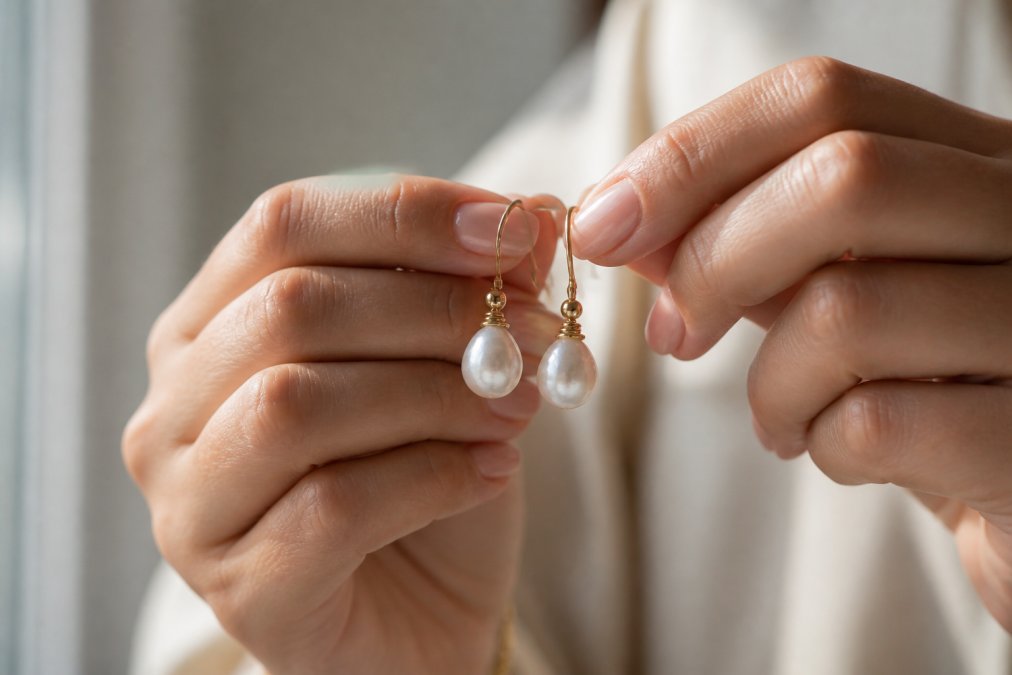
The strongest pair for most wardrobes is a hand-set stud or short drop in 8-9mm freshwater pearls with a sterling silver or gold-plated setting. That size reads as fine jewelry without tipping into costume territory and works from morning meeting to dinner.
Below are the pairs worth your attention this year, grouped by how you will actually wear them.
Baroque and Keshi Pearl Styles for Statement Looks
Baroque pearls have an organic shape, and keshi pearls are the small, irregular byproducts of the culturing process. Neither is a defect, both give a one-of-a-kind silhouette no matched pair can copy.
The Antique White and Pink Baroque Pearl Drop Earrings pair warm white and pink tones in 18k gold plating for $220.00. The Luxurious White, Pink and Purple Freshwater Pearl Earrings with Green Jade push further, adding natural green jade for $405.00.
What most guides miss: baroque pairs should be matched for visual weight, not identical shape. If one earring hangs heavier than the other, the asymmetry stops looking intentional.
Gold and Silver-Tone Designs for Everyday Wear
For daily wear, choose a stud or a short drop with a secure post. The Natural Freshwater Pearl Knot Style Stud Earrings in 18k gold plating at $380.00 sit flat against the lobe and survive a full workday.
If you want a diamond accent without the price of solid gold, the Diamond and Freshwater Pearl Earrings pair 8-9mm pearls with inlaid zircon in 925 sterling silver for $220.00. The Diamond Star and Freshwater Pearl Earrings at $410.00 lean vintage, and the Butterfly Diamond and Freshwater Pearl Earrings at $315.00 suit softer, romantic styling.
Pearl Grading and Size: Choosing the Right Pair for Your Face Shape
Pearl size changes how a face reads, and 8-9mm is the safe middle for most adults. Below 7mm reads delicate and youthful; above 10mm starts to dominate. Size also interacts with drop length: a 9mm pearl on a 25mm drop sits differently than the same pearl on a 40mm drop, and the longer drop pulls the eye downward.
Face shape decides the silhouette:
- Round face: choose a drop or elongated baroque shape to add vertical line.
- Oval face: almost anything works, so let the pearl size lead.
- Square jaw: soft round studs balance strong angles.
- Heart-shaped face: wider studs or hoops add weight near the jaw.
- Long face: wide studs or clustered designs shorten the visual length.
The Five Factors That Actually Determine Pearl Grade
The Gemological Institute of America (GIA) grades pearls on five factors, and understanding how they interact separates a confident buyer from a hopeful one.
Luster is the sharpness and intensity of the reflection, graded from excellent to poor. Excellent luster is bright, sharp, and nearly mirror-like; poor luster looks chalky or diffused. Luster is the single strongest driver of visual value, a pair with excellent luster and minor surface marks will outshine a flawless pair with flat luster.
Surface quality is graded on how visible the imperfections are, from clean to heavily blemished. For earrings, the face matters most: small marks on the back are normal and usually invisible when worn, while deep pits or cracks on the face are not.
Shape runs from round to baroque. Round is the most valuable because it is the rarest. Baroque and keshi shapes are irregular by nature, not defects, a style choice that often costs less than round pearls of comparable luster and size.
Nacre thickness is the layered coating the mollusk deposits. Thicker nacre means deeper shine and better durability. You cannot measure it from a photo, but thin-nacre pearls look chalky at the edges and often show the bead underneath on close inspection. Freshwater pearls typically carry thicker nacre than akoya because of the tissue-nucleation process.
Matching is how well the two earrings pair in size, shape, color, and luster, where handcrafting earns its premium. A pair graded highly on luster but poorly on matching still looks off when worn, because the eye catches the mismatch before it registers the quality.
How to Read a Pearl Grade Before You Buy
A reputable listing does not need a full GIA report, but it should give you enough to judge the five factors. Look for:
- Luster described in plain terms ("high luster," "mirror-like") rather than just "beautiful."
- Surface described honestly, including any visible marks.
- Shape named (round, near-round, baroque, keshi).
- Nacre referenced, even if only as "thick nacre" or "freshwater."
- Matching addressed, ideally with a photo of both earrings side by side.
If a listing gives you luster and size but nothing on surface or matching, you are buying blind on two of the five factors, the gap between a $105.00 entry pair and a $1,420.00 heirloom. Ask the seller directly before you spend.
Gemological Institute of America pearl grading overview
Handcrafted Pearl Jewelry Care Tips for Daily Wear
Pearls are softer than metal and more sensitive than diamond, so the care routine is simple but non-negotiable. Wipe each pearl with a soft, dry cloth after wearing to remove skin oils and perfume residue. Store the pair in a soft pouch or lined box, never loose in a tray where it can scratch against metal.
Put jewelry on last. Hairspray, perfume, and lotion all leave a film that dulls luster over time.
- Never use ultrasonic cleaners or steam on pearls.
- Keep pearls away from chlorine and household cleaners.
- Restring drop earrings if you notice the wire loosening.
- Wear them. Pearls that sit in a box for years dry out and lose their sheen.
Conclusion
The hard part of buying pearls online is trusting what you cannot touch. The fix is to buy from a maker who names the pearl type, states the metal and stone, and photographs the exact pair you receive.
Glamorous by Katre builds its collection on natural pearls, gemstones, and precious metals, with hand-set settings and transparent specifications on every listing, from the $105.00 Art Deco Geometric Pearl Earrings to the $1,420.00 Victorian-inspired ruby pair.
Search the Glamorous by Katre collection and choose a pair crafted to last a lifetime.
Frequently Asked Questions
How can you tell if pearl earrings are authentic?
Genuine natural pearl earrings have a cool, slightly gritty feel when rubbed against your tooth, while fakes feel smooth. Look for depth in the luster, tiny surface imperfections, and slight variations between the two pearls. Real pearls also feel heavier than plastic or glass imitations. Ask the seller for details on nacre thickness and pearl origin. Handcrafted pieces from reputable jewelers often come with documentation confirming the pearl type and metal content.
What is the difference between natural and cultured pearl earrings?
Natural pearls form inside wild mollusks without human intervention and are extremely rare, which makes them costly. Cultured pearls grow when a technician places a small nucleus inside a farmed mollusk; the animal then coats it with nacre over months or years. Both are real pearls with genuine nacre. Freshwater cultured pearls, like those used in most handcrafted earrings today, offer the same luster and durability at a more accessible price.
How much should real pearl earrings cost?
Handcrafted natural pearl earrings typically range from around $100 for simple gold-plated studs to over $1,400 for pieces with precious stones and intricate settings. At Glamorous by Katre, prices start at $105 for Art Deco geometric designs and reach $1,420 for the Victorian-inspired ruby and diamond pair. Factors that affect cost include pearl size, nacre quality, metal type, gemstone accents, and the level of artisanal craftsmanship involved.
Why choose handcrafted pearl jewelry over mass-market brands?
Handcrafted pearl jewelry is made in smaller batches with closer attention to pearl selection, setting quality, and finishing. Handcrafted earrings from artisans typically use sterling silver or 18k gold plating over solid pins, and each pearl is chosen for its luster and shape.
How do I care for handcrafted pearl earrings so they last?
Put your pearl earrings on last, after perfume, lotion, and hairspray have dried. Wipe them with a soft cloth after each wear to remove oils, then store them in a fabric-lined pouch away from other jewelry. Never use ultrasonic cleaners or harsh chemicals on pearls. Restring or have settings checked every year or two if you wear them daily. With basic care, high-quality natural pearl earrings can stay lustrous for decades.