

Table of Contents
- What You'll Need Before You Start Testing
- Common Gold Jewelry Stamps and Meanings
- Is My Gold Jewelry Plated or Solid?
- Non-Destructive At-Home Tests to Verify Gold Jewelry
- How to Use a Gold Testing Kit Safely
- Professional Appraisal and XRF Testing
- Common Mistakes That Damage Your Jewelry
- Frequently Asked Questions
Last Updated: September 16, 2026
What You'll Need Before You Start Testing
Learning how to verify gold jewelry authenticity starts with preparation, not testing. Rushing into acid or scratch methods without the right tools damages heirloom rings and chains.
Here's your starting kit:
- A strong magnet (neodymium works best)
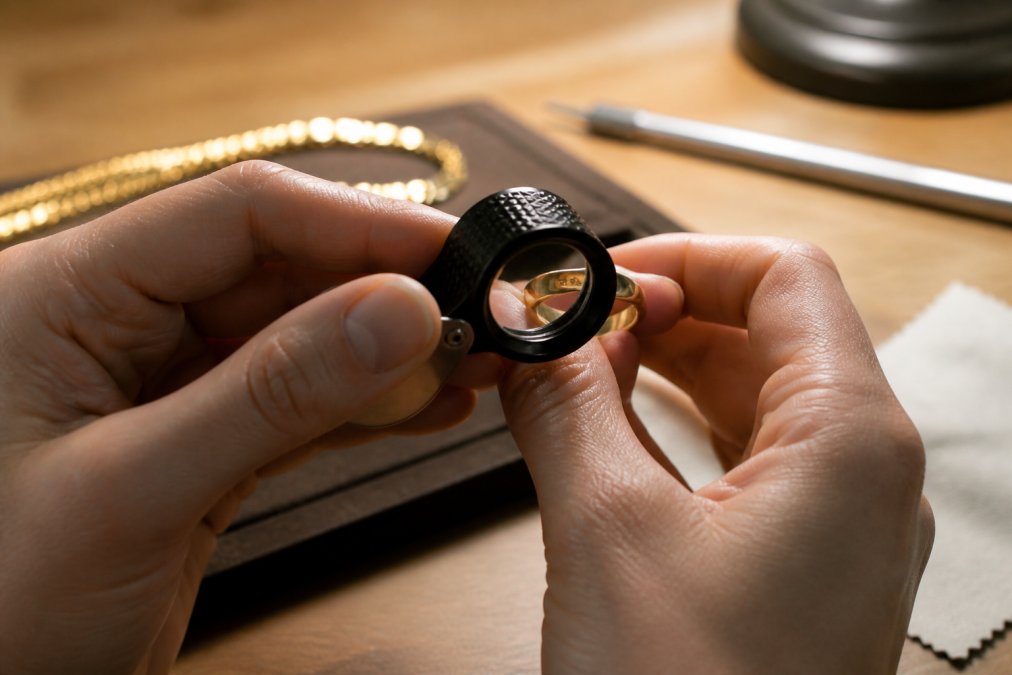
- A jeweler's loupe (10x magnification)
- A digital scale accurate to 0.01 grams
- A small cup of water and a fine thread
- A ceramic plate or unglazed tile
- Nitrile gloves and safety glasses
- A gold testing kit with testing stone and acid solutions
Common Gold Jewelry Stamps and Meanings
A stamp is the fastest starting point, and the easiest thing for a counterfeiter to fake. Understanding common gold jewelry stamps and meanings keeps you from trusting a mark that means nothing.
Understanding Karat Marks: 10K, 14K, 18K, 24K
The karat mark tells you the purity of the gold. Karat is a ratio out of 24 parts, reflecting how much of the metal is gold versus alloy.
| Karat Mark | Gold Purity | Common Use |
|---|---|---|
| 10K | 41.7% gold | Durable everyday rings, budget pieces |
| 14K | 58.3% gold | Most common fine jewelry in the U.S. |
| 18K | 75% gold | Higher-end jewelry, richer color |
| 24K | 99.9% gold | Bullion and coins, too soft for daily wear |
Counterfeit Hallmarks: When a Stamp Lies
A stamp is a claim, not proof. Counterfeiters stamp "14K" or "18K" on gold-plated base metal because buyers rarely check.
Watch for these red flags:
- A stamp that looks printed or laser-etched rather than struck
- Missing maker's mark or country of origin
- Inconsistent font or spacing compared with known pieces
- A karat mark that does not match the color or weight of the piece
Is My Gold Jewelry Plated or Solid?
Knowing whether you have gold-plated, gold-filled, or solid gold changes everything about value, wear, and resale. The answer is usually visible once you know where to look.
Gold-Plated vs. Gold-Filled vs. Solid Gold vs. Vermeil
Each category describes how the gold sits on the piece and wears over time. The names sound similar but describe very different products.
- Gold-plated: A microscopic layer of gold electroplated over a base metal like copper, brass, or nickel. The gold layer is typically measured in microinches (often under 0.5 microns), and it wears through with regular use. There is no federal minimum thickness for the term "gold-plated," which is why quality varies wildly.
- Gold-filled: A thicker layer of gold mechanically bonded (heat and pressure) to a base metal core, usually brass. Under the U.S. Federal Trade Commission's Jewelry Guides, gold-filled items must be marked with the fraction of gold by weight, such as "1/20 14K GF," meaning gold makes up 1/20th of the total weight and that gold is 14K. The gold layer is roughly 50 to 100 times thicker than typical plating.
- Solid gold: Gold alloy all the way through, with no base metal core. Karat stamps like 10K, 14K, and 18K describe solid gold alloys. "Solid" here means not hollow and not layered, not 24K pure.
- Vermeil: Sterling silver (92.5% silver) with a gold layer of at least 2.5 microns, and the gold must be at least 10K. The FTC Jewelry Guides set that 2.5-micron floor, which is why vermeil is legally distinct from plain gold-plated silver.
How Each Type Wears Over Time
The wear timeline is the practical difference. Plated jewelry may show base metal within months of daily wear, especially on rings and bracelets. Gold-filled pieces commonly last years, which is why vintage gold-filled chains are still wearable. Vermeil sits between the two, and solid gold never wears through.
How to Tell Them Apart Without Damaging the Piece
The practical tell: solid gold feels denser and warmer, and does not reveal a different color metal at worn edges. Plated and filled pieces show base metal at the clasp, link edges, and anywhere the piece rubs against skin.
A few concrete checks:
- Read the stamp carefully. "14K" or "585" alone suggests solid. "14K GP" or "14K HGE" (heavy gold electroplate) means plated. "14K GF" or "1/20 14K" means gold-filled. "18K over sterling" or "18K vermeil" means vermeil.
- Look at the edges under a loupe. On a plated piece, the gold layer is thin enough that the base metal often peeks through at the sharpest edges of links and prongs.
- Weigh it against expectations. A solid 14K chain of a given length and gauge has a predictable heft; a plated chain of the same dimensions feels noticeably lighter.
- Check the color consistency. Plated pieces sometimes show a different gold tone on the clasp or findings, which are often sourced separately and plated in a different batch.
Non-Destructive At-Home Tests to Verify Gold Jewelry
Non-destructive tests let you check a piece without scratching, dipping, or altering it, the safest first-line methods before any chemical test.
The Magnet Test
Gold is non-magnetic, so a genuine solid gold piece should not stick to a strong magnet. This is the easiest and least risky test.
The Water and Density Test
Gold is dense, and that density is hard to fake. A water displacement test estimates specific gravity by comparing the piece's weight in air to its weight suspended in water.
Here's the method:
- Weigh the dry piece on a digital scale. Record the weight.
- Fill a cup with water and suspend the piece by a fine thread so it hangs fully submerged without touching the sides.
- Weigh the submerged piece and record it.
- Divide the dry weight by the difference between the two weights.
Visual Inspection for Discoloration and Tarnish
Discoloration and tarnish tell a story about what is underneath. Solid gold does not tarnish or rust, so any of these signs points to a base metal core:
- Green or black marks on your skin where the piece sits
- Dark patches at the edges of links or inside a band
- A reddish or gray tint showing through worn gold
- Pitting or flaking on the surface
How to Use a Gold Testing Kit Safely
A gold testing kit gives the most reliable at-home answer, but only if you handle the chemicals correctly. Acid testing is the one method here that can genuinely hurt you or the piece.
The Acid Scratch Test and Nitric Acid Precautions
The acid scratch test works by scratching a small line of metal onto a testing stone, then applying acid to see how the mark reacts. Different acid strengths correspond to different karats.
Safety comes first, every time:
- Wear nitrile gloves and safety glasses. Nitric acid causes immediate skin burns and permanent eye damage.
- Work in a ventilated space, ideally near an open window or with a small fan moving air away from you.
- Keep a bowl of baking soda and water nearby to neutralize spills. Baking soda neutralizes acid on contact.
- Never test a finished piece directly. Scratch the stone, not the jewelry.
- Store testing acids upright, capped, and out of reach of children and pets, away from ammonia and other household cleaners.
- Dispose of used stone shavings and neutralized solution per local household hazardous waste rules, not down the drain.
Why This Test Damages Vintage and Delicate Pieces
- Vintage jewelry with soft solder joints. Old repairs and solder seams can crack under the pressure needed to leave a good scratch mark.
- Filigree and hollow pieces. Thin walls deform easily, and a deformed filigree piece loses most of its resale value.
- Pieces with prong-set stones. Pressing the metal against the stone can loosen a prong or chip a fragile gem.
- Plated and vermeil pieces. The scratch removes the gold layer at that spot permanently, leaving a visible bright line of base metal.
The Vinegar Test: What It Can and Cannot Tell You
The vinegar test is popular because it uses a household ingredient, but its limits are real. White vinegar is a mild acid (acetic acid, usually around 5%), far weaker than the nitric acid in a proper kit.
Professional Appraisal and XRF Testing
For anything valuable, an XRF analyzer and a licensed appraiser give you the only answer that holds up. XRF testing is non-destructive: it reads the metal's elemental composition using X-rays and reports the exact percentage of gold, silver, copper, and other metals.
Common Mistakes That Damage Your Jewelry
The most expensive mistakes happen when people skip preparation and go straight to the harshest test available. The ones we see most often:
- Acid-testing the jewelry instead of a scratch mark. This permanently etches the surface and can destroy a plated finish.
- Testing a piece with gemstones or pearls still set. Acid and even vinegar can damage porous stones and strip nacre.
- Trusting a single test. No home method is definitive alone. Combine the magnet, visual inspection, and density checks before concluding.
- Bending or filing a piece to "check inside." This cracks solder joints and voids resale value.
- Assuming a stamp is proof. Counterfeit hallmarks are common, so verify the mark against the metal's actual behavior.
Frequently Asked Questions
How can I verify the authenticity of gold jewelry at home without damaging it?
Start with the non-destructive methods: check for hallmarks using a jeweler's loupe, hold a magnet to the piece (real gold won't stick), and inspect for discoloration or tarnish in crevices. Weigh the item and compare against its expected density in water. These tests won't harm your jewelry and can flag obvious fakes, though they cannot confirm exact karat weight the way an XRF analyzer or professional appraisal can.
Can a ring be real gold if it is not stamped?
Yes, but it is less common. Older pieces, handmade items, and jewelry from certain regions may lack a hallmark. The absence of a stamp doesn't automatically mean the gold is fake, but it does mean you should verify through other methods like density testing or professional XRF analysis. If you are buying a piece without a stamp, ask the seller for documentation or an appraisal before committing.
Does the magnet test actually work for gold jewelry?
The magnet test is a useful first filter, not a definitive answer. Gold is non-magnetic, so a piece that sticks to a magnet is definitely not solid gold. However, many base metals like copper and brass are also non-magnetic, so a piece that doesn't stick could still be gold-plated or a counterfeit alloy. Use the magnet test alongside hallmark checks and density testing for a fuller picture.
Can vinegar test gold?
Vinegar can reveal some base metals because they may discolor or react, but it cannot confirm gold purity. Real gold is nonreactive to vinegar, so a piece that shows no change passes that one check but could still be gold-plated over a nonreactive base metal. Vinegar is safe for most jewelry, but it won't tell you the karat or whether the gold layer is thick enough to last.
Verifying gold at home gets you a strong signal, but a professional XRF reading or appraisal is the only definitive answer for anything valuable. At Glamorous by Katre, we believe you should never have to guess what you are wearing, which is why our pieces come with clear material details, including 18k gold plated copper construction and specified stone types on every listing. Explore the collection and choose jewelry with craftsmanship you can actually verify.